For the last fifteen years, the internet has been built on a single, inefficient verb: Upload.
We’ve been conditioned to think that for anything “smart” to happen, we have to send our data to a giant computer in the cloud. We wait for the progress bar, we wait for the server to think, and then we wait to download the result. In 2026, this model is finally dying. The rise of local-first design software has turned the “Upload” button into a symbol of a legacy, slower era.
Today, the most advanced AI tools don’t want your data; they want your hardware.
The Friction of the Cloud vs. The Fluidity of the Browser
Every time you click “Upload,” you are introducing a bottleneck into your creative flow. You are limited by your ISP’s upload speed, server congestion, and the physical distance between you and the data center. By using a tool like PixelStacker, you eliminate the “Transit Tax” entirely.
When I use a local-first design software workflow, the tool feels like an extension of my hand. There is no “Thinking…” spinner. The AI model is already in my browser’s memory, waiting for my next move.
Why 2026 is the year of “In-Situ” Processing
“In-Situ” means “in place.” Instead of moving the image to the AI, we move the AI to the image. This is made possible by WebAssembly (WASM) and ONNX Runtime.
– Privacy: Your high-value client assets never touch a third-party server.
– Reliability: You can process images even if the tool provider’s servers are down.
– Speed: Processing starts the millisecond you drop the file.
The Security Advantage of Local-First Tools
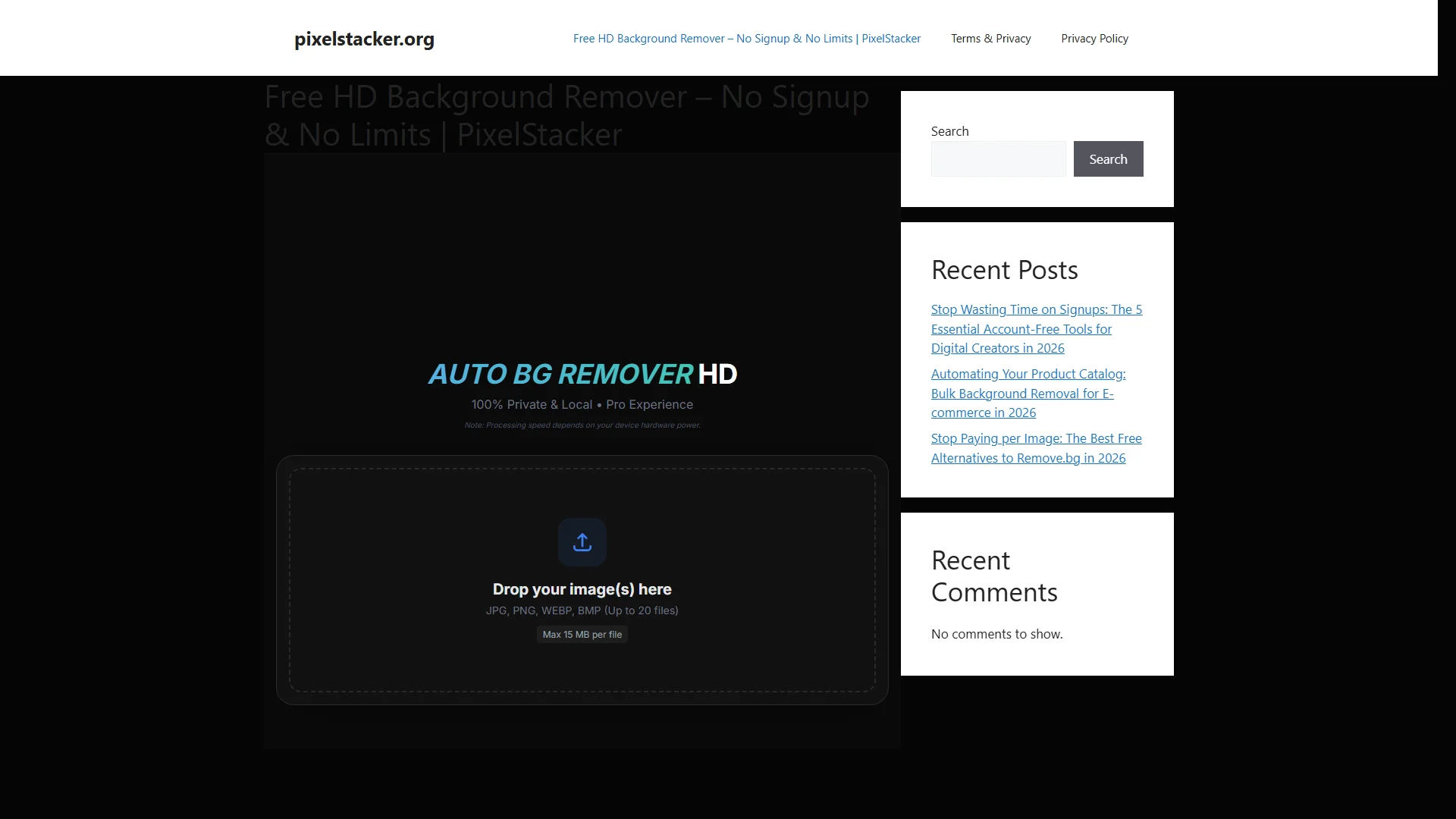
I once worked with a legal firm that needed 400 document scans cleaned up. Their compliance department forbid any “Cloud Processing.” If I had relied on legacy tools, I would have had to do it all manually or buy an enterprise-level offline license. Instead, I used a Free HD Background Remover that runs entirely in the browser sandbox.
The compliance officer watched me work. He saw the network activity monitor stay flat at 0kb/s during the processing. He was stunned. That is the power of local-first design software.
Alex Carter’s Verdict
The “Cloud” was a necessary middle step, but it was never the destination. The future is local. Stop being a data donor for big tech and start using tools that respect your privacy and your bandwidth. Reclaim your workflow.
You might also like:
- Why WASM is the most important technology in your browser workstation.
- How to build a professional design stack for $0 in 2026.